





Ed Yong
Pulitzer Prize-winner and bestselling author of An Immense World
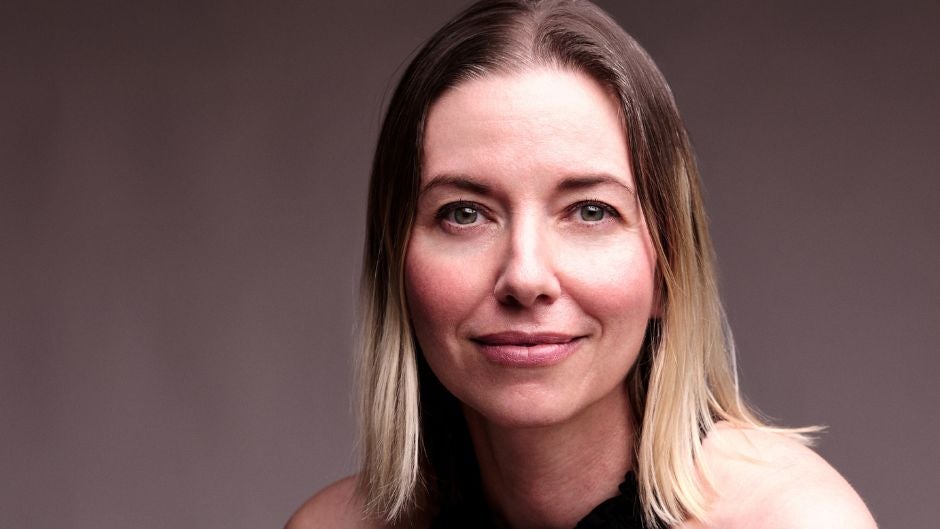
Photo credit: Minhee Bae
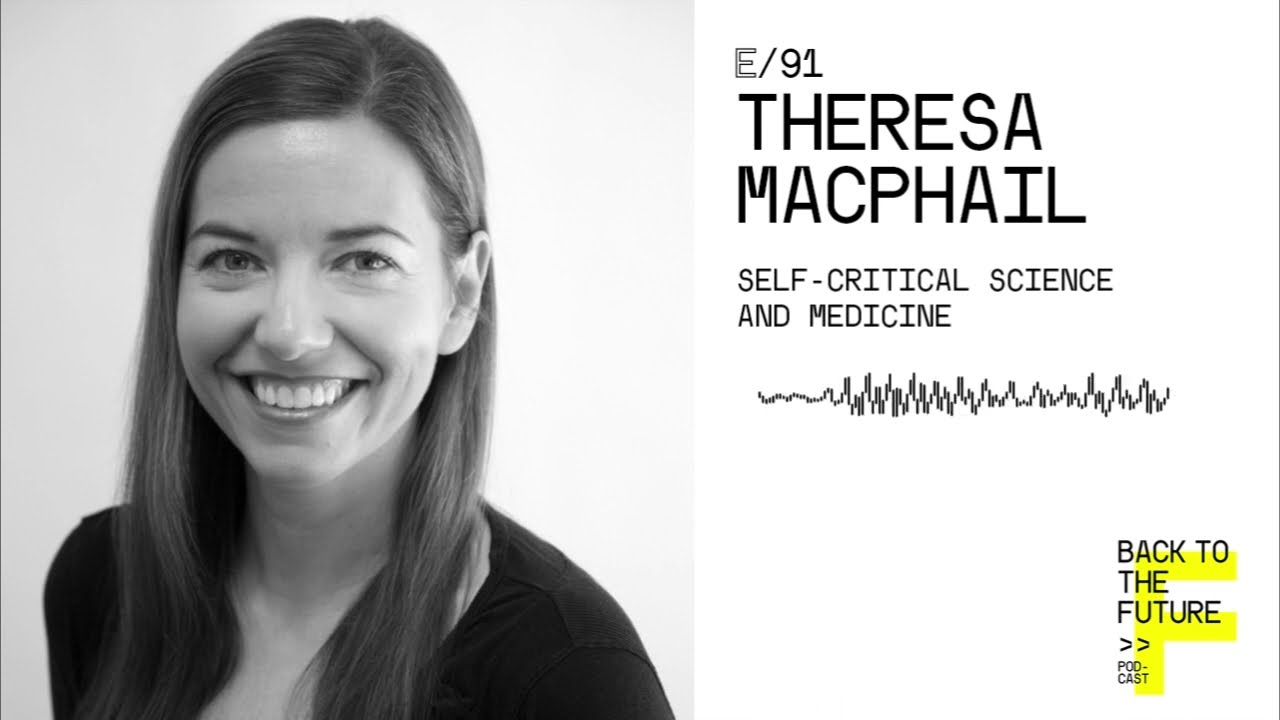
Theresa MacPhail is driven by a curiosity about our bodies, our world, and the myriad unconscious conversations that take place between them. A medical anthropologist, former journalist, and professor with a background in global health, biomedicine, and disease, she blends her research with philosophy, history, and social sciences to make sense of our present moment. In her fascinating talks that touch on everything from the relationship between global and local health to the importance of failure, she brings lessons from the classroom and her research to a wide range of audiences, from college students to corporations.
For Theresa MacPhail’s new book, Allergic: Our Irritated Bodies in a Changing World, she set out to unravel the mystery of why the number of people diagnosed with allergies has been steadily increasing over the last half century, placing a growing medical burden on individuals, communities, families, and our healthcare system. A holistic and historical examination of allergies, Allergic spans from their first medical description in 1819 to recent innovations. Along the way, MacPhail makes surprising discoveries and connections between climate change, pollution, and biologists, that underscore how interconnected our bodies are to our environments.
In addition to her research on epidemics and allergies, MacPhail talks about our wider societal relationship with “unknowledge” and failure. In persuasive lectures, she explains that people don’t understand that science is just as much about what we don’t know as what we do. She explores the link between misinformation, mistrust, and the public’s lack of comfort with the level of uncertainty that scientific inquiry requires, arguing not only that the public needs to learn how to be more comfortable with uncertainty, but that scientists need to get better at admitting what they don’t know.
As a college professor, MacPhail also has witnessed a rise in anxiety and depression among her students, which she credits to their crippling fear of failure. Too often, students are told that they should learn from their failures, but they don’t know how. In her “Failure 101” course and talks aimed at audiences of all ages, MacPhail normalizes failure by talking about historic, relationship, and business failures and concepts like groupthink and growth vs. fixed mindset.
Theresa MacPhail is an Associate Professor of Science and Technology Studies at Stevens Institute of Technology in Hoboken, NJ. She earned PhDs from the University of California, Berkeley, and the University of California, San Francisco. In addition to Allergic, her writing has appeared in Slate and The Los Angeles Review of Books, and her academic work has been published in Public Culture, Limn, and Expertise: Cultures and Technologies of Knowledge. MacPhail is currently working on her next book, which dives into what happens to our minds and bodies as we age, and why acceptance of aging is the key to “aging well.” She lives in Brooklyn, NY.
From hay fever to eczema to peanuts, either you have an allergy or you know someone who does. In this engaging talk, Theresa MacPhail guides you on a journey to answer some of the most pressing questions about the global epidemic of allergic diseases: what they are, why we have them, and what that might mean about the fate of humanity in a rapidly changing world. Because understanding what is irritating us and why will help us to craft better environments in the future—so we can all breathe easier.
Tuberculosis. Zika. Polio. Influenza. HIV. Ebola. Cholera. West Nile. Each of these diseases has been, in their turn, at the center of collective public worry and public health responses. To anyone paying attention to the news headlines, it seems we are constantly in a battle with a different virus or bacteria. And yet, we never seem to stay focused on any public health threat for long. The news cycle moves on and the disease of the day fades into the background – even when the epidemic is still ongoing. MacPhail explores how and why we often forget about epidemics and what they might be able to teach us about the practice of public health. The price we might pay for forgetting what we’ve learned is too high to ignore.
Over the past decade, Theresa MacPhail noticed that her students, the majority of whom were STEM majors, were more and more anxious and stressed out about their futures. After a spate of suicides rocked her university, she designed an experimental course—“Failure 101”—to teach students about the concept of failure – how we define it, what it looks like in different fields, how it is experienced in day-to-day living, and how to learn to welcome it as a necessity for a successful and fulfilling life. In this talk, Dr. MacPhail offers insights from her experiences teaching college students how to fail and why she believes learning how to fail is more important than learning how to be happy. In the end, she argues that accepting failure may be the ultimate antidote to anxiety.
Our desire to control aging is nothing new. Some of the earliest medical texts contain detailed advice for longevity and retaining vitality into old age. Newspaper articles written about centenarians well over a century ago seem modern in their contents, containing tips from early “super agers” on proper nutrition, exercise, and lifestyle habits for a long life. In 1915, Dr. Arthur Lorand, an Austrian physician and one of the earliest longevity researchers, recommended regularly drinking fresh pig’s blood to supplement the iron and gland extracts (or hormones) that began to diminish in old age. Newspaper articles printed in 1901 suggested consuming more salt - posited as the “true elixir of life” - and rubbing olive oil all over the body to halt its aging.
These days, much of that advice now comes with a patina of new scientific jargon that makes it seem more achievable than ever before. Studies using cell or mouse models that have shown small, but significant, anti-aging benefits are often touted as being future “cures” for human aging, sparking not only hope but self-experimentation. Popular anti-aging experts and proponents like Dr. Peter Attia and Bryan Johnson admit to having used the immunosuppressant drug rapamycin off-label in an effort to slow their own aging, despite little longitudinal scientific evidence that it works. This new hope that modern science can stop aging in its tracks, promoted by some physicians and social media influencers alike, is ironically creating a much bigger social problem – a doubling down on a new type of scientific ageism that is harming us as we inevitably age.
A recent linguistic study found that “age stereotypes have become more negative in a linear way over 200 years. In 1880, age stereotypes switched from being positive to being negative.” This shift correlates to the rise of microbiology and the more recent rise of scientific research on biological aging. Russian scientist Elie Metchnikoff, widely regarded as the “father” of immunology, coined the term gerontology and gave the science of anti-aging its first boost in the early 1900s. Metchnikoff’s research was the very beginning of modern anti-aging and highlights how the cell became the center of our aging world and the focus of all our hopes for longer and longer lives, and microbiologists became its priests as well as its purveyors.
This talk explores the last 200 years of “anti-aging” science and how the promotion of modern science-backed anti-aging – with its anti-aging creams, supplements, and biohacking – is creating a new scientific ageism and how focusing on healthspan instead of anti-aging might be a much better option for all of us if we want to have a happier, healthier old age.
Comprehensively researched, deftly told, and radiating both intellect and passion, Allergic is essential reading for anyone interested in our bodies and our world. I am grateful to have this book to share with my allergy patients.
An astute, empathetic, and wonderfully informative investigation . . . Theresa MacPhail makes a persuasive case that cooperation—with each other and with our internal ecosystems—is the key to relief.
Allergic is just the sort of thoughtful, comprehensible, and comprehensive book we urgently need to understand how rapidly changing modern environments are interacting with our ancient immune systems to cause a frightening explosion in allergies.
A fascinating account that most of us (sniffle sniffle) will find of compelling interest—and also a powerful reminder that what we do to the world around us eventually affects the world inside us.
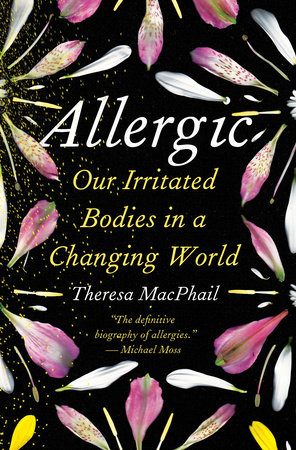
“Allergic is the definitive biography of allergies. This accessible, comprehensive, and troubling portrait should be read by all who suffer and those who care about them, which, as MacPhail so carefully documents, is such an astounding number that it includes almost all of us.”—Michael Moss, bestselling author of Salt Sugar Fat and Hooked